
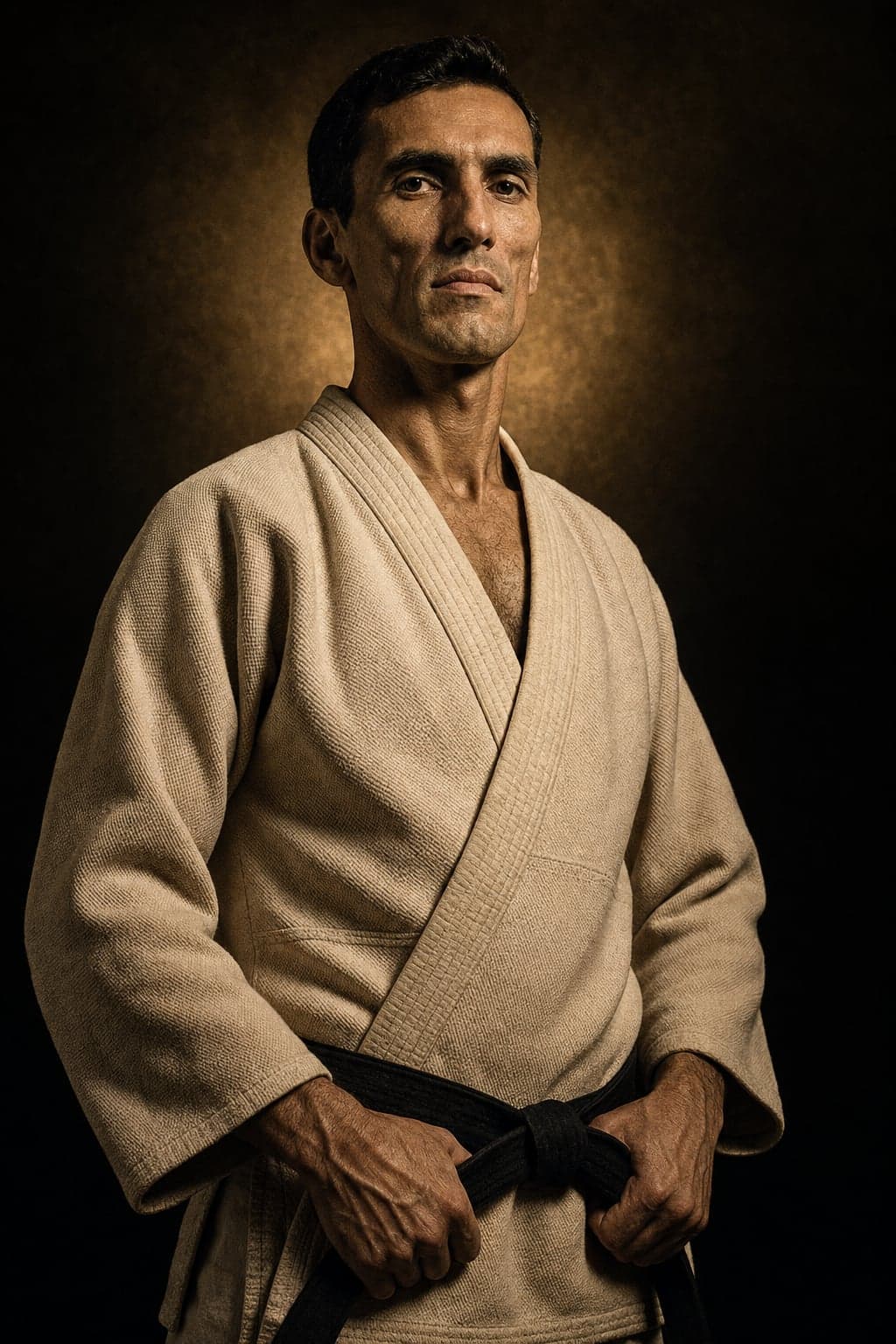
Hélio Gracie
“Caxinguelê / O Caçula”
O Caçula — the frail youngest Gracie who remade Maeda’s judo into leverage for the smaller man, endured Kimura’s broken arm, and lived to see his sons carry the art into the octagon.
- Team
- Academia Gracie / Gracie Jiu-Jitsu
- Weight class
- Lightweight by modern standards (~62–68 kg / 137–150 lb)
- Height
- 5'7"–5'9" (170–175 cm)
- Born
- –
- Birthplace
- Belém, Pará, Brazil
The Story
A long-form history in 8 chapters
Before the UFC, before the global academies, before “Brazilian jiu-jitsu” was a language spoken on every continent — there was a thin boy from Belém who was told his body was too weak for the mats. Hélio Gracie, the youngest of the fighting brothers, watched from the sidelines until one missed appointment turned him from observer into teacher. What he built from that moment was not strength’s art. It was survival’s.
Across challenge matches against boxers, wrestlers, and judoka — and in the two nights that defined his myth, against Masahiko Kimura and Waldemar Santana — Hélio proved a doctrine: timing, leverage, and will could answer size. He co-founded Gracie jiu-jitsu with his brothers, raised a dynasty of champions, and coached Royce from outside the cage when the world first learned what the family had been saying for decades.
This is the saga of the Squirrel — Caxinguelê — from the Amazon mouth to Rio’s academies, from the Maracanã’s roar to a quiet morning in Petrópolis at ninety-five: the grandmaster who never stopped teaching, and whose art still teaches the world that the smaller man need not lose.
Chapter 1
I. The Youngest of Belém
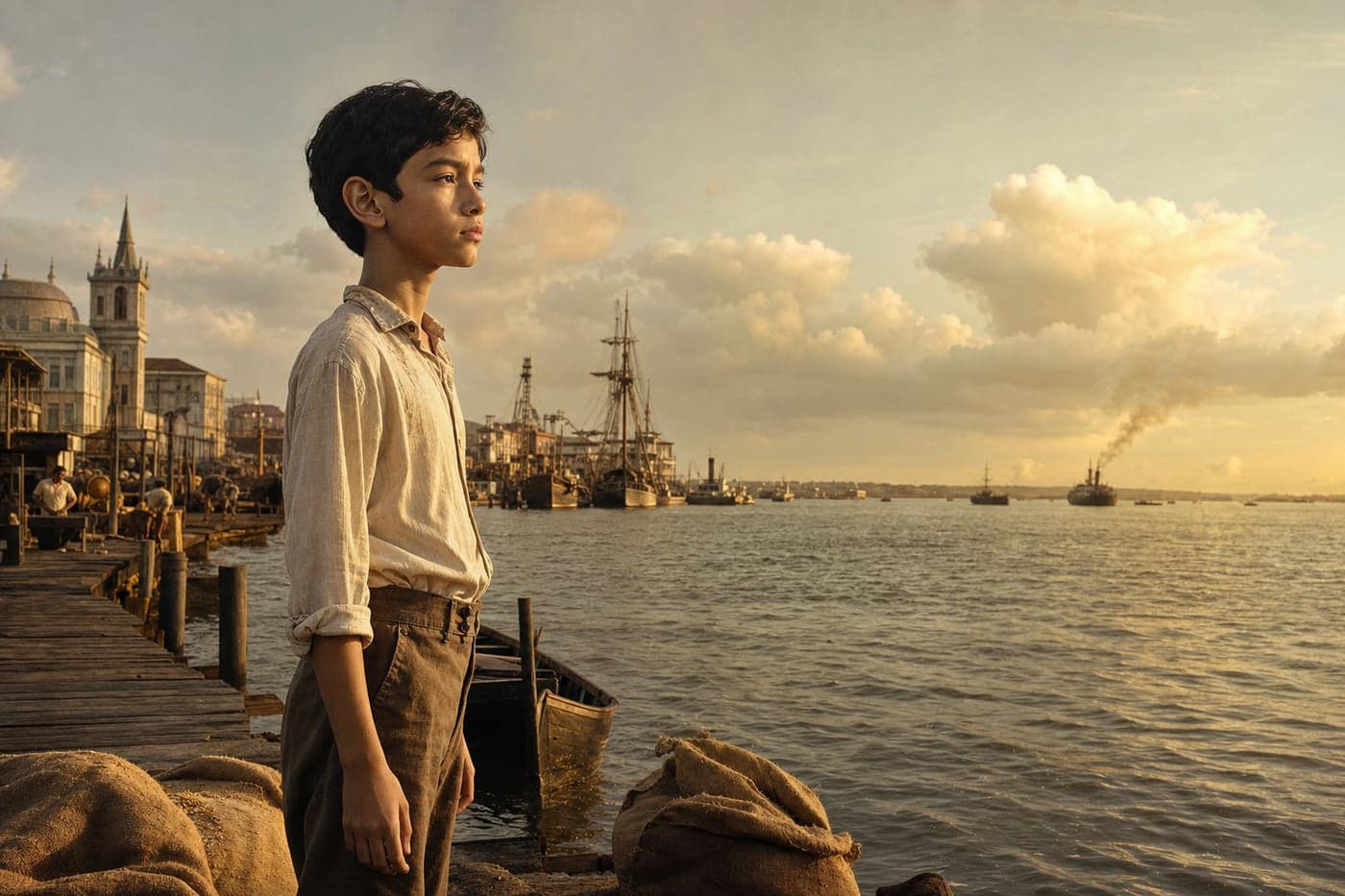
Hélio Gracie was born on October 1, 1913, in Belém do Pará — the same river city where Mitsuyo Maeda had made challenge matches into legend and taught an older brother named Carlos. He was the youngest boy among the children of Gastão Gracie, a Scottish-descended businessman, and Cesalina; in a household of louder, stockier brothers he stood out as tall and lanky, light as a squirrel on a branch. The family called him O Caçula — the youngest — and later Caxinguelê, the squirrel: quick, slight, impossible to ignore.
Popular memory paints him as permanently frail. The fuller truth is more human. As a child he swam and rowed; he had athletic hunger. He also suffered dizzy spells and fainting that doctors could not tidy into a simple diagnosis, and for long stretches the mats were forbidden. In 1921, after the family’s fortunes cracked, the Gracies left Belém for Rio de Janeiro. The move did not cure him. It placed him in the city where jiu-jitsu would become a Brazilian religion — and where a boy who could not yet train would learn by watching.
Carlos, the eldest, had taken Maeda’s fighter’s judo and made of it a mission. In 1925 he opened what is remembered as Brazil’s first dedicated jiu-jitsu academy in Rio. He brought brothers Oswaldo, Gastão Jr., Jorge (George), and eventually Hélio into the work — partly for help, partly to pull the youngest out from under a hard home. Hélio’s body was still a question mark. His eyes, on the technique, were already answering.
Chapter 2
II. The Lesson Carlos Missed
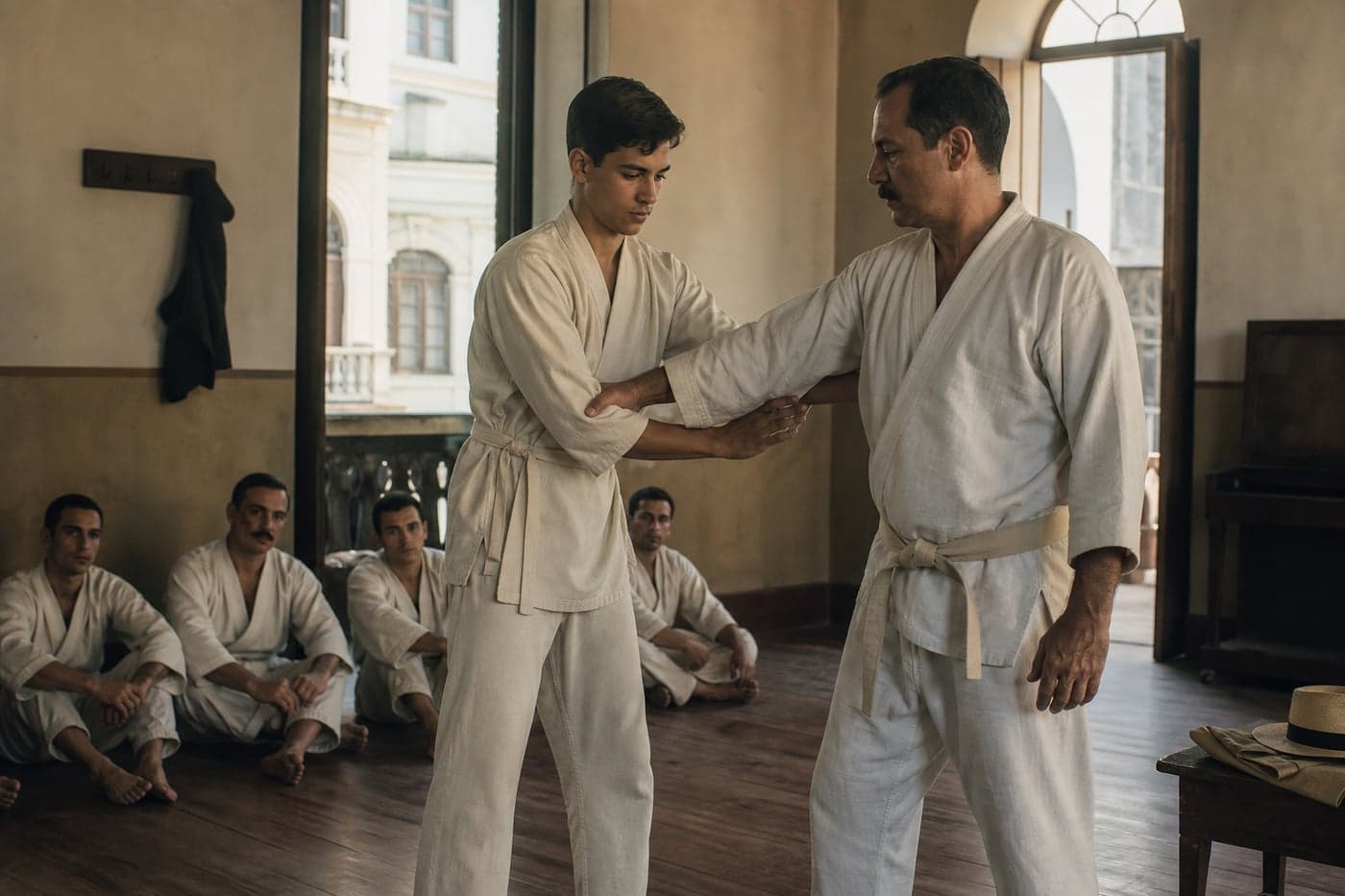
At sixteen, Hélio finally crossed from spectator to participant. He trained judo — still often called Kano jiu-jitsu — with Carlos and George, and catch wrestling under Orlando Américo “Dudú” da Silva, who taught the brothers for a time. He absorbed the curriculum the way a musician memorizes a score: by ear, by eye, by endless repetition in the mind before the body was trusted to play it.
Then came the hinge story of Gracie history. Mario Brandt, director of the Bank of Brazil, arrived for a private lesson. Carlos was late. Rather than turn away an important student, Hélio offered to teach. When Carlos rushed in with apologies, Brandt waved them off — and asked to continue with the younger brother. Carlos agreed. The observer had become the instructor.
Permission did not equal power. Hélio discovered that techniques he understood theoretically refused his thin frame. Hip throws that Carlos could blast through stalled. Pins that required chest and shoulder mass slipped. So he began the quiet revolution that would define him: he rebuilt the game around leverage, timing, and the ground — the phases where a smaller man could invent equality. What emerged from those experiments, refined beside his brothers, was Gracie jiu-jitsu: Maeda’s traveled judo rewritten for the body that could not afford to be strong.
Chapter 3
III. The Art of the Smaller Man
The doctrine was simple and radical. Do not meet force with force. Pull the fight into the guard. Threaten the neck and the joints. Use the opponent’s weight as the engine of his own defeat. Where Kodokan throwing culture still prized the spectacular standing win, Hélio’s Rio school treated the mat as the true courtroom — and patience as a weapon.
He kept studying beyond the family. Accounts place him under judoka such as Sumiyuki Kotani and the Argentine pioneer Chugo Sato; Masahiko Kimura later spoke of him as a sixth dan in judo, while Kodokan paperwork of the era sometimes listed him lower — a familiar gap for non-Japanese practitioners. Rank was never the point. Proof was. The Gracies issued open challenges: boxers, wrestlers, judoka, anyone willing to test the claim that a smaller, technical fighter could survive and win.
Hélio’s fighting weight hovered near 140 pounds. His opponents often did not. The academy on the walls of Rio became both school and proving ground. Students learned self-defense as a science; the public learned, through newspapers and packed halls, that the Gracie name meant a wager against size itself.
Chapter 4
IV. The Challenge Years
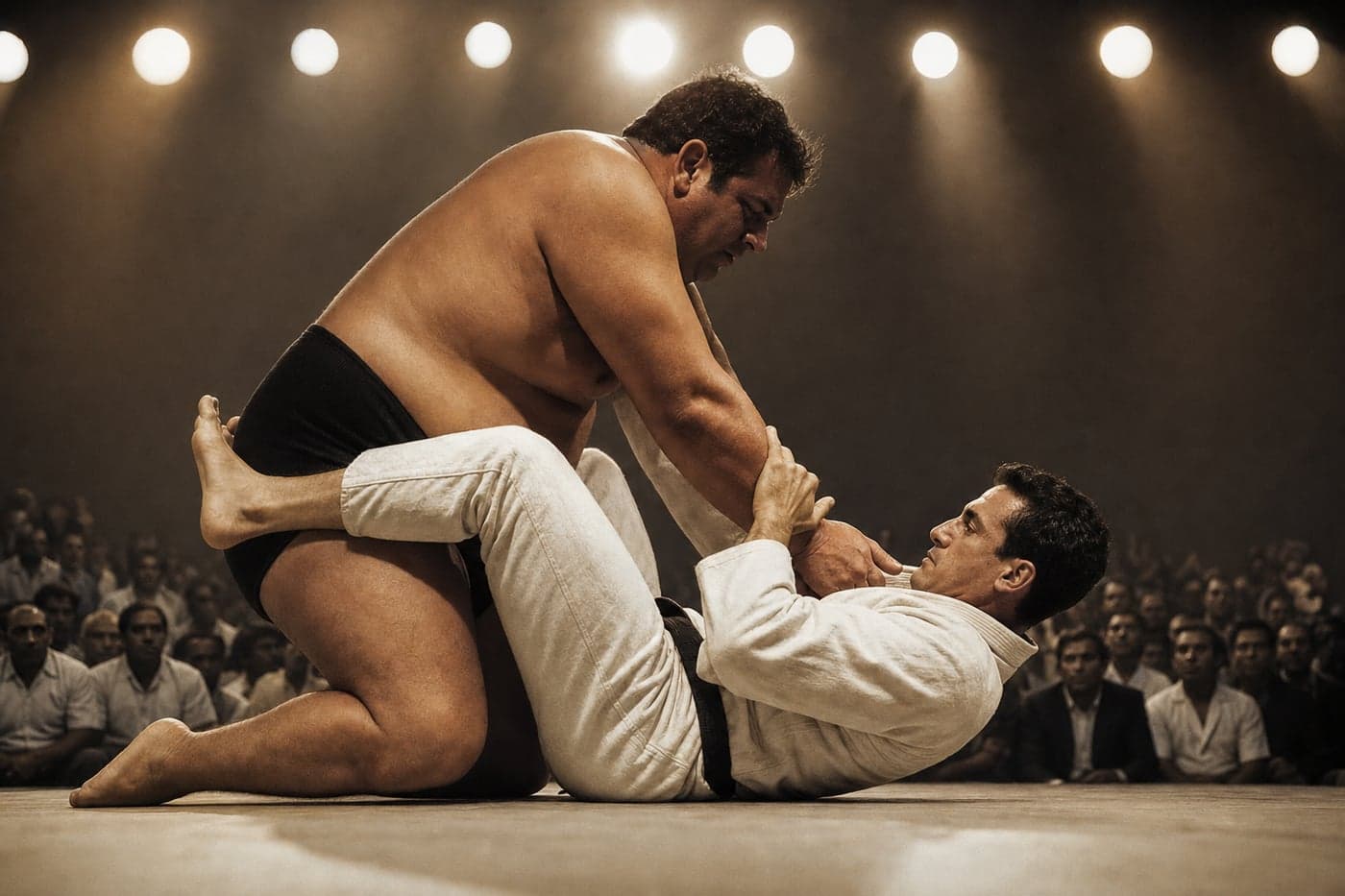
Hélio’s professional career opened on January 16, 1932, against boxer Antonio Portugal. The finish came fast — an armlock in roughly forty seconds. The same year he drew with Takashi Namiki and then endured nearly two hours against freestyle wrestler Fred Ebert, who outweighed him by some sixty pounds, before police stopped a bout that neither man could close. Moral victories and draws piled up beside submissions; the myth was being built in public, fight by fight.
He choked Miyaki unconscious from the mount in 1934. Against giant catch wrestler Władek Zbyszko — world-famous, vastly heavier — he pulled guard and lasted the limit for a draw that the crowd read as courage. In 1935 he beat his own former catch teacher Dudú in a vale tudo, absorbing punishment, breaking free, and finishing when the bigger man’s gas tank emptied. Against judoka Yasuichi Ono and Takeo Yano he was thrown dozens of times and never quit, demanding matches without judges and wearing shortened sleeves to deny easy grips. He submitted Massagoishi and Erwin Klausner. The newspapers sometimes scoffed; the academy kept filling.
In 1937 he stepped away from competition for more than a decade. When he returned around 1950 he was no longer only a young challenger — he was the face of a family system. He even challenged visiting boxing champion Joe Louis to vale tudo; Louis declined and offered boxing rules instead. Hélio refused. The art would meet the world on the ground, or not at all. The hardest nights were still ahead.
Chapter 5
V. Kimura at the Maracanã
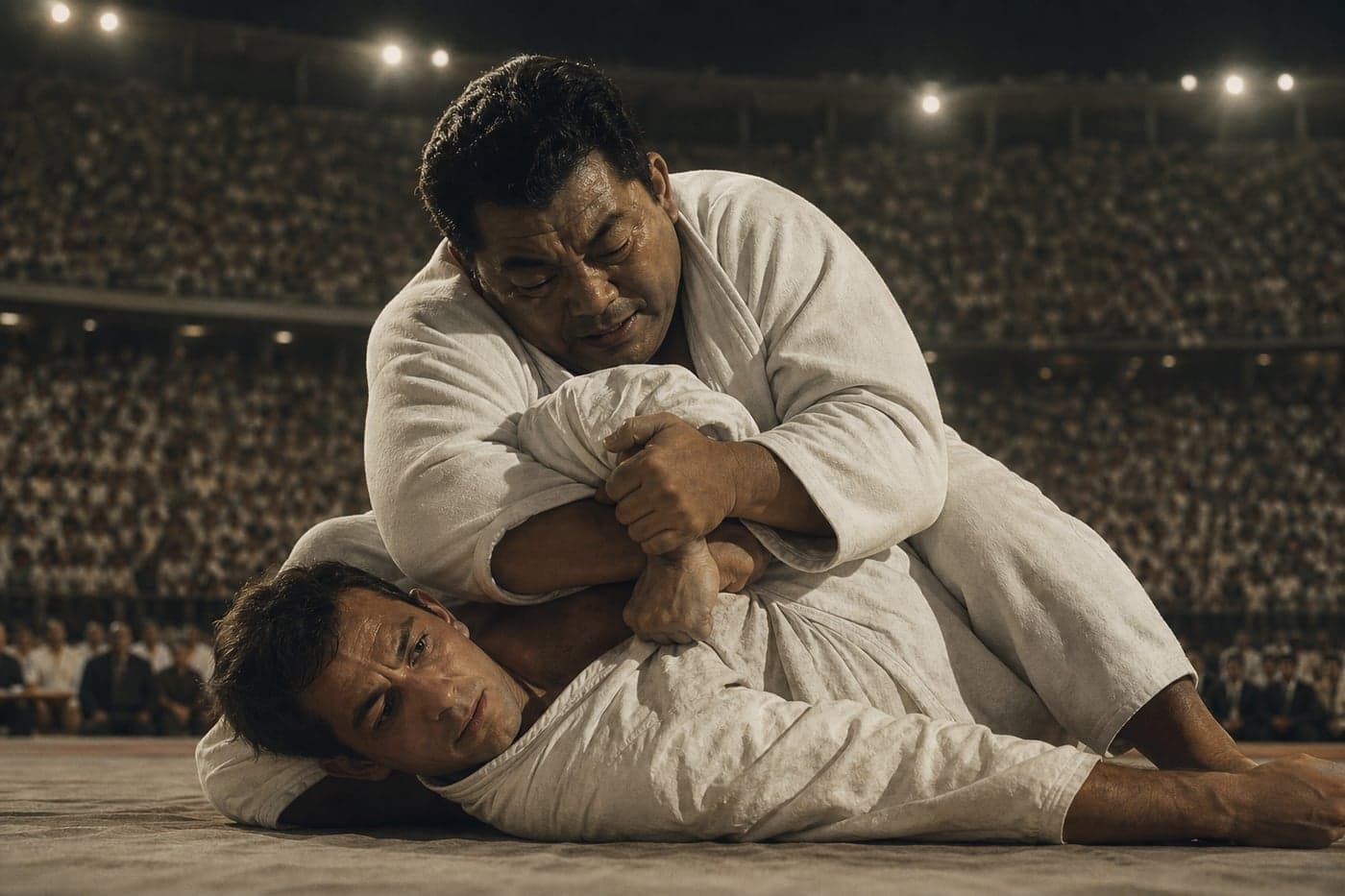
In 1951, Masahiko Kimura — perhaps the greatest judoka alive, touring as fighter and showman — arrived in Brazil. The press crowned him the world’s jiu-jitsu champion and needled the Gracies. Hélio answered the way the family always had: with a challenge. First he faced Yukio Kato of Kimura’s troupe — a draw in Rio, then a rematch in São Paulo that Hélio won by choke. Only then would the main event be granted.
On October 23, 1951, they met at the Maracanã Stadium before a crowd measured in the tens of thousands. Kimura threw; Hélio endured. In the first round the Japanese pinned and attacked; at one point Hélio briefly lost consciousness under pressure and woke as the hold changed, nodding that he could continue. In the second round Kimura planted him with osoto-gari, held kuzure-kami-shiho-gatame, then seized the arm for gyaku-ude-garami — the reverse entanglement the world would rename the Kimura.
Hélio did not tap. Kimura broke the arm. Still no tap. He broke it again. Carlos Gracie threw in the towel and tapped Kimura’s back — the only surrender Hélio would allow that night. Defeat, and yet something stranger than defeat: a Brazilian audience had watched a smaller man refuse to quit against the best Japan could send, and a technique had been baptized in his pain. Decades later, every academy that teaches the Kimura is still telling a chapter of Hélio’s story.
Chapter 6
VI. The Longest Night
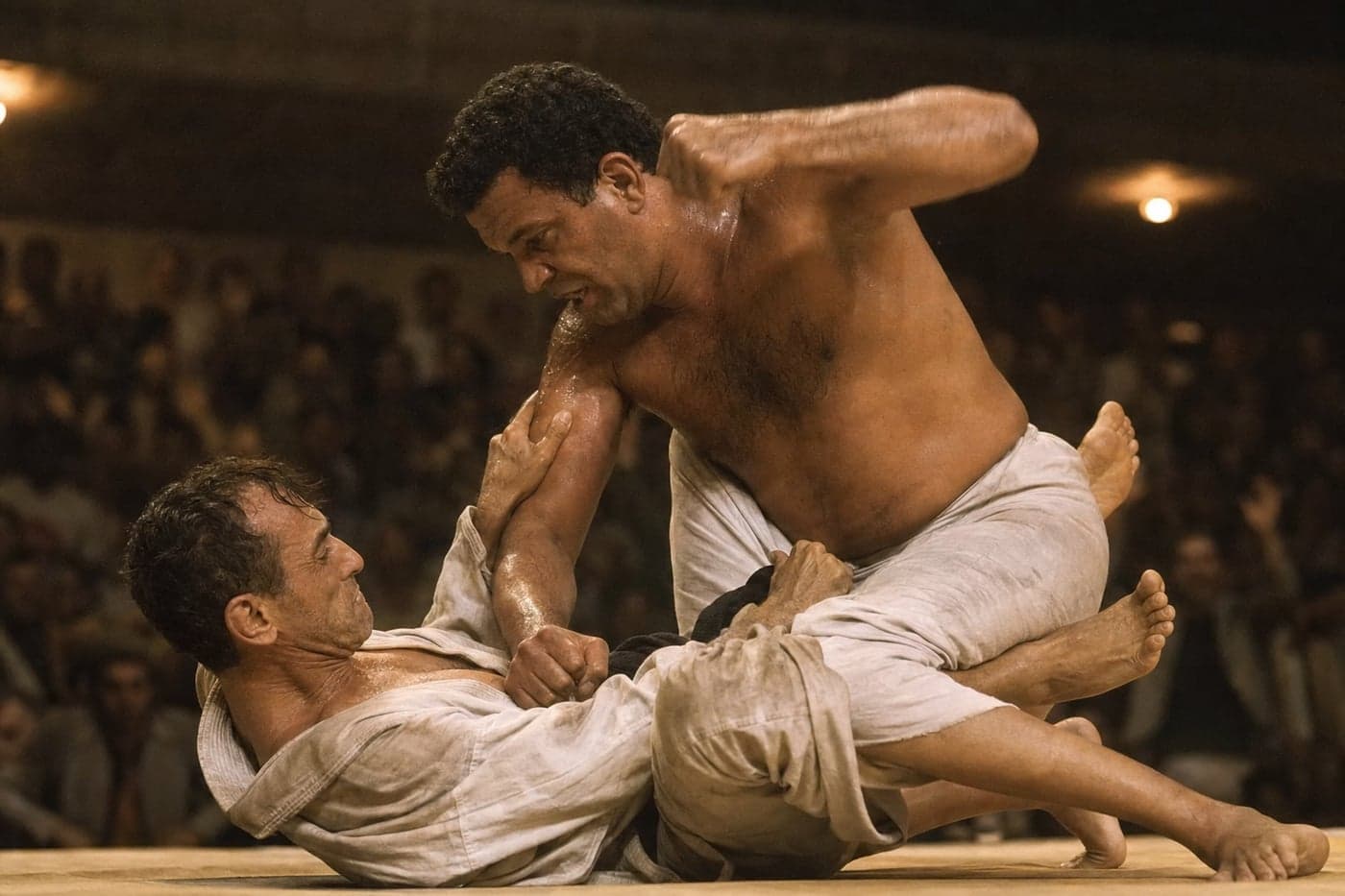
Four years later came the other pillar of the legend. Waldemar Santana — former Gracie Academy student, younger by sixteen years, heavier by roughly sixty pounds — challenged his old master. Motives blur in the retellings: a forbidden pro-wrestling bout, a flooded gym, pride, money. Hélio, in his early forties, accepted a vale tudo with no clock that mattered.
They fought in Rio in May 1955, both in the gi, for a stretch the newspapers and later oral history place near three hours and forty minutes — among the longest combats in modern fight memory. Hélio spent vast stretches in guard, elbowing and heel-kicking from his back while Santana punched through. Fatigue accumulated like weather. Near the end Santana slammed him and finished with a soccer kick to the head; Hélio was knocked out, the towel came in, and the fighting career effectively closed.
Loss again — and again, not only loss. The next day, tradition holds, a line of new students formed at the academy. Carlson Gracie would later avenge his uncle against Santana in a series that packed arenas. Hélio’s point had never been an undefeated ledger. It had been the demonstration that jiu-jitsu could keep a smaller man alive against youth, weight, and time itself — for hours, if required.
Chapter 7
VII. Sons of the Patriarch
Retirement from the ring was not retirement from the art. Hélio taught for the rest of his life. His sons — Rorion, Relson, Rickson, Royler, Rolker, Royce, Robin, and daughters among a wide family — carried branches of the tree across Brazil and, eventually, the world. Grandsons such as Ryron, Rener, Kron, and others became black belts and ambassadors. Students like Rolls Gracie and Carlos “Caique” Elias extended the technical line still further.
Rorion took Gracie jiu-jitsu to Southern California and helped invent the stage on which the claim would be tested before a global audience: the Ultimate Fighting Championship. At UFC 1 and UFC 2, Hélio stood outside the cage as Royce — lean, calm, wearing the family gi — submitted larger men from other arts while the broadcast stammered to explain guard and choke. The old Gracie Challenge had gone electronic. The doctrine Hélio had embodied since the 1930s was suddenly the most famous argument in combat sports.
He was named Black Belt magazine’s Man of the Year in 1997 and inducted into the Martial Arts History Museum Hall of Fame. He wore the red belt of a grandmaster — remembered as a 10th-degree in Brazilian jiu-jitsu, a living founder rather than a tournament circuit champion. The belts of the modern sport descend, in story after story, through his name.
Chapter 8
VIII. The Eternal Grandmaster
Hélio Gracie died in his sleep on the morning of January 29, 2009, in Itaipava, Petrópolis, at ninety-five. The family said natural causes. He had been teaching and training on the mat until ten days before. The frail boy who once could not climb stairs without dizziness had outlasted nearly a century — and had spent the last of it still correcting grips.
Scholars still argue the balance of credit between Carlos and Hélio, between Maeda’s Belém transmission and Rio’s reinvention, between myth and newspaper record. Those debates matter. They do not erase the silhouette history kept: the youngest brother who adapted the art for the weaker body; the challenger who filled halls; the man who let Kimura break his arm rather than tap; the teacher whose children made “Brazilian jiu-jitsu” a worldwide mother tongue of the ground.
Today, when a white belt learns to frame from guard, when a black belt traces a lineage through Helio Gracie, when a smaller athlete beats a larger one by timing alone — the Squirrel is still in the room. Hélio Gracie. O Caçula. The grandmaster who proved that leverage is a kind of faith, and that faith, practiced long enough, becomes an art the whole world trains.
Lineage
2 generations from Mitsuyo Maeda
- Mitsuyo Maeda
- Carlos Gracie
- Hélio Gracie (current athlete)
- Co-founder of Gracie jiu-jitsu / Brazilian jiu-jitsu with brothers Carlos, Oswaldo, Gastão Jr., and George
- 10th-degree red belt grandmaster in Brazilian jiu-jitsu; also held high judo rank (reported 6th dan)
- Primary architect of leverage-based adaptations that defined classical Gracie jiu-jitsu for the smaller practitioner
- Gracie Challenge pioneer — decades of public challenge matches vs boxers, wrestlers, and judoka (1930s–1950s)
- Defeated Yukio Kato by choke (1951) to earn the bout with Masahiko Kimura
- Faced Masahiko Kimura at the Maracanã (Oct 23, 1951) — the gyaku-ude-garami finish forever known as the Kimura
- Fought Waldemar Santana in a ~3h40m vale tudo (1955) — among the longest fights in modern combat history
- Patriarch of a fighting dynasty including Rorion, Relson, Rickson, Royler, Royce, and many grandchildren
- Coached Royce Gracie at UFC 1 and UFC 2 as Gracie jiu-jitsu reached a global audience
- Black Belt magazine Man of the Year (1997)
- Martial Arts History Museum Hall of Fame inductee (2001)
- Taught on the mats until ten days before his death at age 95 (January 29, 2009)