
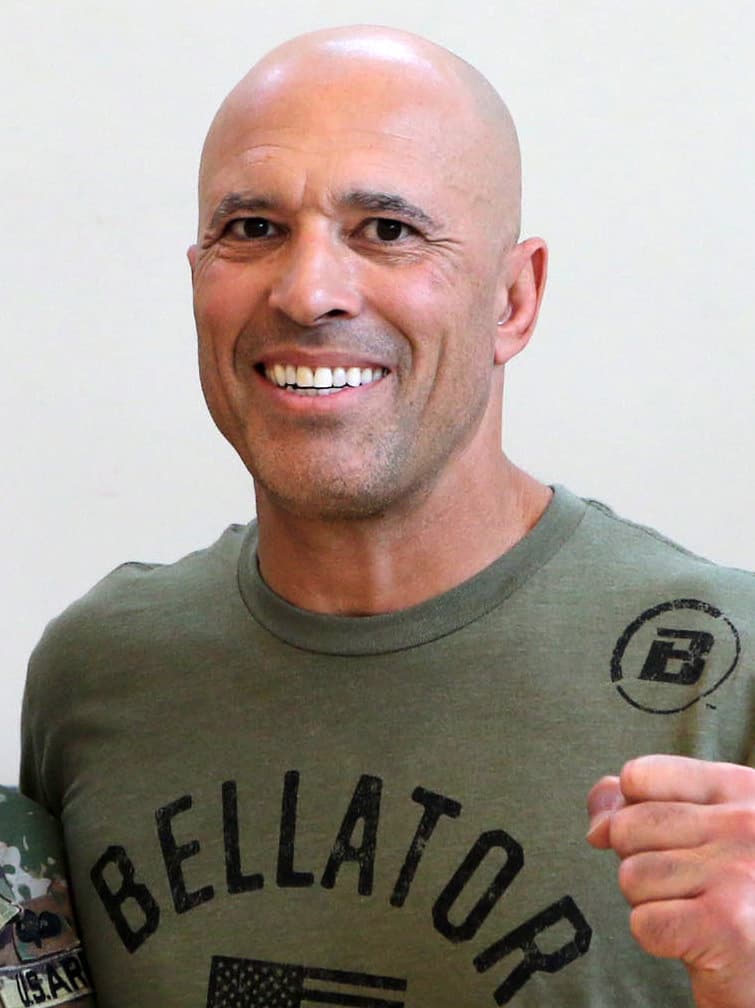
Royce Gracie
The original Ultimate Fighter — UFC 1, 2, and 4 tournament champion whose Gracie jiu-jitsu rewrote combat sports forever.
- Team
- Gracie Humaitá / Team Royce Gracie / Royce Gracie Jiu-Jitsu Network
- Weight class
- Openweight (early UFC) / Middleweight–Light Heavyweight MMA (~176–188 lb)
- Height
- 6'0" (183 cm)
- Born
- Birthplace
- Rio de Janeiro, Brazil
Biography
Royce Gracie is the fighter who made the world believe in Brazilian jiu-jitsu. Born December 12, 1966, in Rio de Janeiro, the son of grandmaster Hélio Gracie was chosen by his brother Rorion to represent the family art at the first Ultimate Fighting Championship — not because he was the biggest Gracie, but because he was skinny enough to prove the point. At roughly 180 pounds in a gi, he walked into openweight, nearly no-rules tournaments and submitted boxers, kickboxers, wrestlers, and shootfighters who outweighed him by fifty pounds or more. He won UFC 1 (1993), UFC 2 (1994), and UFC 4 (1994) — the only three-time UFC tournament champion in history, and still the only man to defeat four opponents in a single night of no-holds-barred competition (UFC 2). That run did more than build a résumé: it exported Gracie jiu-jitsu from closed-door challenges into living rooms worldwide and forced every serious combat athlete to learn the ground game.
Jiu-jitsu was not a late conversion for Royce; it was the family language. He began training as a toddler under Hélio and older brothers including Rorion, Relson, Rickson, and Royler, competed by age eight, and was teaching classes at fourteen. Hélio awarded him a black belt at seventeen — slightly ahead of federation age rules — in a ceremony co-hosted by Rickson. After an unremarkable early black-belt competition debut in Brazil, he moved to Torrance, California, with Rickson and Royler to help Rorion grow the Gracie Academy. There the brothers continued the Gracie Challenge tradition of full-contact proof against other martial arts. Footage from those challenge matches, later compiled as Gracie in Action, helped convince Art Davie that America was ready for a style-versus-style spectacle — the event that became the UFC.
UFC 1 in Denver (November 12, 1993) remains the origin story of modern MMA. Royce entered in the iconic Brazilian jiu-jitsu gi as the lightest man in an eight-fighter openweight bracket. He mounted and forced a tap from one-armed boxer Art Jimmerson, took Ken Shamrock’s back for a gi choke in the semifinals after surviving a heel-hook scramble, and rear-naked-choked Kyokushin/savate champion Gerard Gordeau in the final to become the first Ultimate Fighting Champion. At UFC 2 he had to win four fights in one night: lapel choke over Minoki Ichihara, armbar over Jason DeLucia (a prior Gracie Challenge opponent), lapel choke over 250-pound judoka Remco Pardoel, and a ground-and-pound finish of Patrick Smith in the final. UFC 3 brought a brutal quarterfinal win over Kimo Leopoldo by armbar, after which exhaustion forced Royce to throw in the towel before the next round — the first tournament he did not win. He answered at UFC 4 by submitting Ron van Clief, Keith Hackney, and finally Pan American freestyle wrestling gold medalist Dan Severn with a triangle choke at 15:49, becoming the first and only three-time UFC tournament winner. His UFC 5 superfight rematch with Shamrock for the inaugural Superfight Championship ended in a 36-minute draw after time limits were reintroduced; shortly afterward Royce and Rorion left the organization as rules, judges, and weight classes began reshaping the sport they had ignited.
Beyond the Octagon, Royce’s career carried the same thesis into Japan’s biggest stages. In PRIDE’s 2000 openweight Grand Prix he decisioned Nobuhiko Takada, then fought Kazushi Sakuraba for ninety minutes under special Gracie-requested rules — still among the longest fights in MMA history — before a broken femur forced his corner to throw in the towel. He later contested controversial “judo vs. jiu-jitsu” special-rules bouts with Olympic judo gold medalist Hidehiko Yoshida, submitted former yokozuna Akebono (Chad Rowan), roughly 480 pounds, with an omoplata in just over two minutes at K-1 PREMIUM 2004 Dynamite!!, returned to the UFC at UFC 60 against Matt Hughes (TKO loss), avenged Sakuraba by decision in 2007, and closed his rivalry with Shamrock via first-round TKO at Bellator 149 in 2016. His professional MMA record stands at 15–2–3, with eleven wins by submission. In November 2003, at UFC 45, he and Shamrock became the first inductees into the UFC Hall of Fame — the Pioneer Wing’s charter class — recognition that his early tournament dominance had permanently redirected the sport toward grappling and ground fighting.
As a jiu-jitsu figure, Royce’s dominance was never measured primarily in IBJJF medals; it was measured in the art’s global proof. He showed that leverage, guard, mount, and submissions could neutralize strikers and wrestlers who had never been forced to fight off their backs. A rare pure grappling superfight against Wallid Ismail at Oscar de Jiu-Jitsu in 1998 ended in a clock-choke loss, a reminder that his legend lived in vale tudo more than sport points. Today he is a seventh-degree coral belt under the Gracie lineage who often trains in a dark blue belt in homage to Hélio, who favored blue after the old two-color academy system. Through the Royce Gracie Jiu-Jitsu Network he teaches a self-defense-first interpretation of Gracie jiu-jitsu worldwide, arguing that sport specialization should not erase the art that made a 180-pound man the most important fighter of the 1990s. For Brazilian jiu-jitsu practitioners, his UFC run remains the foundational public demonstration: technique over size, position before submission, and the ground as the great equalizer.
Lineage
3 generations from Mitsuyo Maeda
- Mitsuyo Maeda
- Carlos Gracie
- Hélio Gracie
- Royce Gracie (current athlete)
- UFC 1 Tournament Champion (1993) — first Ultimate Fighting Champion
- UFC 2 Tournament Champion (1994) — only fighter to defeat four opponents in one NHB/UFC night
- UFC 4 Tournament Champion (1994) — first and only three-time UFC tournament winner
- First inductee into the UFC Hall of Fame, Pioneer Wing, with Ken Shamrock (UFC 45, November 2003)
- Defeated significantly larger opponents throughout early UFC using Gracie jiu-jitsu submissions (rear-naked choke, armbar, triangle, lapel chokes)
- UFC 5 Superfight Championship draw vs. Ken Shamrock (36 minutes) — longest fight in UFC history
- Longest fight in PRIDE history — 90 minutes vs. Kazushi Sakuraba (PRIDE Grand Prix 2000 Finals)
- Submitted former sumo yokozuna Akebono (~480 lb) via omoplata in 2:13 (K-1 PREMIUM 2004 Dynamite!!)
- Professional MMA record 15–2–3 (11 submission wins) across UFC, PRIDE, K-1/Hero’s, and Bellator
- Bellator 149 TKO win over Ken Shamrock, completing their trilogy (2016)
- Fight Matrix Fighter of the Year (1993); Black Belt Magazine Competitor of the Year (1994)
- Wrestling Observer Newsletter Fight of the Year (2000) — vs. Kazushi Sakuraba
- World MMA Awards Lifetime Achievement (2013)
- Martial Arts History Museum Hall of Fame (2007); International Sports Hall of Fame (2016)
- Seventh-degree Brazilian jiu-jitsu coral belt; founder of the Royce Gracie Jiu-Jitsu Network
- First competition at age 8 under Hélio Gracie
- Began teaching Gracie jiu-jitsu classes at age 14
- Awarded black belt by Hélio Gracie at age 17 (ceremony co-hosted by Rickson Gracie)